Showing posts with label movies/films. Show all posts

Tuesday, September 25, 2012

Aliens (1986) as Political Metaphor

If you haven't seen it recently, Aliens (1986) is worth a look.

I mean, a corporate shill seeking profits at all costs. A former warrant officer who's been through hell, trying to make her way back to the world is called to a suicide mission under false pretenses. She's accompanied by a contingent of (Colonial) Marines slated to do the corporation's heavy lifting under false pretenses of their own: a pittance with the promise of greater glory and national duty. Only to be sacrificed as expendable in the face of an apocolyptic menace. The baddest among the heroes' ranks, two women and a little girl, all of whom are the embodiment of survival. And to top it all off, a faceless corporation acting as puppet master.

All I'm saying is when the hell did Wall Street and CEO's become the nation's heros? After this movie, I couldn't even watch "Mad About You", I hated Paul Reiser's character in "Aliens" (Burke) so much. I could hardly feel warm and fuzzy about a CEO, post-Union Carbide and in the midst of savings and loan bailouts. And in the balance, we have Ellen Ripley, Vasquez, and Newt. The working class mother, the soldier, and the future. Battered and bloodied but unbowed. There go you heroes! And in a final ballet of mecha-Tai-Chi who should arise as humanity's salvation? Ripley. Even when she's down, you can never count her out! We may not have Ripley yet, damned if we need another Burke.

And as the creepy skittering noises post-credits prove, even with Ripley on our team, we might not be able to "sleep all the way home", but at least we've got Hope.

Saturday, June 06, 2009

The Freshest Kids - a review

The Freshest Kids is a true and vivid history of Hip Hop. To many people, breakdancing died an embarressing death in the eighties as a played out fad. To many people like me, when the commercial fad ended, we were still amazed to see its heartbeat continue however faint in its hollowed out husk, only to see it come roaring back to life. In my case, at the Chinatown Y in Boston, where a group of Asian, Black, Latino, and a smattering of White kids were busy adding hand springs, flips, and other acrobatics to the traditional windmills, backspins, and body rockin.

The Freshest Kids puts 2 and 2 together, showing but 4 the the strength of the artform, its rough and ready roots, and the heart and soul of its originators, Madison Avenue might well have won the day. But all things that are hard fought, well-crafted, and elemental are indeed enduring. So it is with the B-Boys and B-Girls, God bless them all.

A story of the human spirit, it reminds us to be inspired by kids, their creativity, ingenuity, and explosive power when you remove the shackles of pretense and oppression in its other other pernicious forms. Because these kids with less than nothing, took only what they brought with them and made something that reaches through space - across the world to people and places they'd never seen - and time - back to ancestors they never knew they had. They truly are and ever will be The Freshest Kids.

Sunday, December 02, 2007

Gangster America

Spoiler Alert: I discuss some background about the feature film American Gangster of which you may not be aware before seeing the film. I myself wasn't fully aware of it, nor that the film dealt with it so, I wanted to forewarn readers who might wish to see the movie and enjoy finding out for themselves the many levels this excellent movie traverses.

There are a number of films this year being touted as Hollywood's reaction to the war and political crisis in Iraq and here at home. Most notable among these perhaps are Lions for Lambs, Rendition, and Charlie Wilson's War. The films critics and commentators probably will not and as of yet have not included on this list is Ridley Scott's American Gangster. Starring Denzel Washington, American Gangster is the story of Frank Lucas, heir apparent to Harlem organized crime leader Ellsworth "Bumpy" Johnson. Lucas would establish a heroin distribution network that outstripped any existing in the U.S. at the time, baffling New York police, federal narcotics enforcement, and competing organized crime operations.

It is not the story of Frank Lucas himself however, but its backdrop that warrants American Gangster's inclusion in, and placement at the top of the aforementioned list. It is the America of Vietnam and Nixon. An America still reeling in the wake of the civil rights struggle and the upheaval of national Jim Crow and international Jim Crow in the form of colonial rule. It was also an America led by an individual who by accounts of close advisors as well as his own audio recordings was perhaps the most powerful, drug/drink-addled paranoiac of the modern age. A man whose attempted heist of the U.S. presidency would precipitate his downfall. America was a gangster on foreign shores being led by no less than a gangster.

Through Lucas' story, we are reminded of Major General Smedley D. Butler, USMC, who wrote I was a racketeer. A gangster for capitalism. We are haunted by the warnings of former President and General Dwight D. Eisenhower who stated in his farewell address we must guard against the acquisition of unwarranted influence, whether sought or unsought, by the military-industrial complex. Lucas' ascendancy to dominance of the Eastern U.S. heroin trade was facilitated by the U.S. military presence in southeast Asia during the Vietnam Conflict. In that way, legitimized gangsterism opened the path to more nefarious gangsterism. Exchange Abu Ghraib for Harlem housing projects, water-boarding for no knock warrant, BlackWater for Special Investigation Unit, War on Terror for War on Crime. Where war-making ends do war crimes begin, or is war-making itself the war crime?

The irony of Frank Lucas' story lies in its conclusion. The heroic efforts and character of Richie Roberts, New Jersey Detective and co-prosecuter in Lucas' case, ultimately brought Lucas to justice. Despite the years they spent as adversaries the two found more in common with each other than their respective peers. They bonded, and together uncovered and brought down one of the nations biggest police corruption scandals. Strangely enough, Robert's first case as a defense attorney would be that of Frank Lucas, defending Lucas against the very crimes for which he'd originally prosecuted him.

I hearken back to the whistle-blowers of the late 90's and early 00's. Their own steadfast integrity, crises of conscience, or both, coupled with herculean struggle called to account some of our country's most powerful organizations including Enron, WorldCom, big tobacco (ironically featured in another Russel Crowe film, The Insider), and the FBI. It is a parallel I can only hope and pray continues into our present day as another gangster presidential administration winds to its own conclusion. If only that means we too will conclude our collective chapter as American Gangsters. That the Lucases and a Roberts, or other Insiders within us will come to the fore. Maybe then can we finally enter our own second act and call to account the gangsters whom we as a nation - in politics, business, military, religion and other global affairs - have ourselves supported and/or created.

Tuesday, March 21, 2006

Judging a Film by Its Book Cover

I wonder if studios know how tough they make it for themselves when their reps give you a survey before you walk into a theater. As soon as I get one of those creamy, would-be soothing sheets, my senses go on alert. My skin draws into goosebumps. The hair on the my nape goes on end. It asks me my sex. A woman yammering behind me distracts me for a second and I check female (MISTAKENLY). It asks me my age. Range. Ever since I was 3 I've been thinking of my age as a precise crisp number, not a range! What's with the trick questions!?! Race. Of course. Hollywood bastards. That way they know which opinions to put in the throwaway pile. Well at least they put "Black/African-descent", and not "African-American" like some stupid forms.

[Imagine the indignity of a Nigerian or Kenyan, just visiting the country and deciding he wanted to check out a movie, only to have a form shoved in his face that tells him he's "African-American." Who pulled the switch on my passport? Or think of the Brit or Italian national for that matter (yes, there are Black Europeans! Even a few whose forebears went there voluntarily!!)? Or how's this for mindbending: you're an Indian from Uganda. What do you say then? Huh? Or how pray tell should Theresa Heinz-Kerry answer on such a form? Didin't think of that one now, did ya??? Silly surveys, trix are for kids.]

But even this little entreaty cannot thwart the coming of my hypercritical self. Like some angry green giant of a movie critic lurking in my subconscious. Mild mannered Bruce Banner that I am would normally be amused momentarily with ridiculously huge mustard yellow polarized glasses. Even the stubby little pencil that comes with the form hearkens back to simpler days when there was nothing one couldn't do with a pencil. No stray mark was indelible. No mistake permanent. Alas, such bliss was only momentary. A palliative, soothing the conscious self to relinquish its hold as monster beneath secured glasses to their perch whilst thumbing the top of his ballpoint like some terrible inky detonator. This friends, was my tenuous grip on reality as I sat down to see the long awaited "V for Vendetta".

For me, two books-made-film have been the standard bearers for said genre: "Lord of the Flies" (the original black and white version), and "Fahrenheit 451". One could argue "Grapes of Wrath" or "The Godfather", and I know the Frodo for President crowd is out there gnashing its teeth in anticipation of locking down on my throat, lithe and tender like a goose. Sorry, Charlie. Get in line behind the "Bridges of Madison County" fans. This is my inch, and I ain't givin' it. Okay. One exception. "High Fidelity". But only 'cause it's John Cusack.

Needless to say, this raises the bar damn high. And 9 times out of 10, even the best (adapted) movies, are mediocre in comparison to the novel. Perhaps even more so with a graphic novel, because unlike a text novel where one must completely imagine settings, and faces, and actions, a graphic novel lays all these out with precision that defies the sharpest camera lenses. Hell, why even make a graphic novel into a movie? Good question.

Well, having eagerly anticipated and now seen "V for Vendetta", I can say why the adaptation is worth the effort.

1) Living parable. Science fiction stories are our modern-day parables. It draws together magic and wonder to warn us of our very mundane human frailties. The story of V is about creating freedom in a society that out of fear has forsaken it in deference to "security". And this was written in the 80's??? Taken as is, the story in its original form is as timely as ever. Well worth a (re)read, even after seeing the movie. However, there is something quite jarring when one sees news footage of the day, OUR day, cut into this fictional cautionary tale. And such a skillfully executed update infuses the parable with new lifeblood. Making a powerful message even more potent by connecting to the accepted and turning it on its head.

2) Flesh, blood, and tears. I don't go in much for movies with a lot of crying. I'll admit it. It scares me. I don't like to cry, and I find the weepy tearjerkers totally manipulative, and I leave them feeling violated. That being said, the most powerful scene in the movie and graphic novel involves Evey Hammond (played by Natalie Portman, "the actress that defines our age" said one WAY too enthusiastic moviegoer walking out behind me when the movie ended) reading a letter she finds in her cell and sobbing and kissing it when she finishes it. These were tears of tremendous sadness and an eternity of pain, but also of defiant and unconquerable love. Her tears are painful, wrenching, triumphant, and joyful. And to have such a scene played by a tremendous actress like Portman (yes, MagnoliaFan walking out behind me was right, but he should have come to that conclusion after seeing "The Professional", as any TRUE Portman fan would have...hah!) is like having a chiropractic adjustment administered to your heart. A visceral moment on paper given bone, flesh, and tears on an IMAX screen no less. My eyes mist and my heart swells simply thinking about it.

3) The Boom Bip. A dark mysterious figure emerges from the shadows. In an elegant frenzy of motion the villain and his henchmen lay thwarted in broken messy piles. We all derive a satisfaction from seeing the truly wicked get their comeuppance. Better still when this vengeance is served in digital surround sound stereo. The snapping of long bones, the swift cuts of the blade, the resonant thud of boot heel to sternum, a triumphant symphony of justice being dealt. One can always imagine using the freeze-frame images a graphic novel provides. But the wonder and magic of the samurai is in that split second pause between his killing stroke and his victims collapse where you can study his face transformed by anger, fear, determination, and possible death. Swiftness of motion, or the illusion thereof, and the power and fury of the bone-crunching deathblow are what make any action comic fan yearn for his favorite books to be made into films. Besides, what's an homage to Guy Fawkes without the thunderous, seat-rumbling, Parliament-leveling fireworks?

Final verdict. Go see it. Then I strongly recommend reading it. Both experiences will change the way you look at your surroundings, the way you breath the air around you, the way you share your life with others (or begin to if you haven't yet started). I have my gripes, of course, having read the book first. And having heard the author's (Alan Moore) own infamous misgivings about the production I didn't want to let Hollywood off too easy. But even in its shortcomings, the filmmakers succeeded where so many others have failed, and attempted and succeeded at things that neither directors, actors, artists, nor writers have dared try. And it's about fucking time.

Saturday, May 14, 2005

Star Wars III - The Phantom dilemma...

...or how I learned to stop worrying and love George Lucas again...or not.
I can't decide whether or not to go see Star Wars III. I'll say this. When I saw Episode I, I was caught between crying, vomiting, and burning down the theatre. Three words. You guessed it. Jar-Jar Binx.

I know very few Black people who didn't writhing in anguish every time Jar-Jar appeared on screen, much less opened his mouth. You may count me among the writhing. I was also immediately struck by how the trade council sounded like an Asian stereotype, and how Anikan's slave master seemed like a horrible Arab or Jewish caricature.

I know, I know. It's just a movie, and a fantasy movie at that. In fact it's a fantasy movie set completely outside the context of America, Earth, and all the stupid prejudices, bigotry, and deep history of insults and injustices that have shaped American history in particular, and world history overall.

Believe me. All the physical writhing I did in my chair at the theatre was nothing compared to the mental and emotional writhing in my head as I reminded my bruised and battered psyche that it's a movie, it's fantasy, it's fun for kids. In The Matrix, Cypher had a point. "Ignorance is bliss."

Too bad I'm not ignorant. What's more, I don't think Lucas can rightly claim ignorance either. The fact that the best defense he's mustered for himself is that the flim is a fantasy totally outside Earth's context only tells me that if the story were placed within Earthly confines, people like me (and a lot more folks like him than he probably thinks) would then have every right to be offended. To add insult to injury, he angrily blamed critics and "the media" - which I suppose would include the humble blog - for getting all us good colored folks worked up over nothing is a patent insult in and of itself. I guess to Mr. Lucas, we are all just sheep with no agency of our own. Critics, he explains are not doers or makers, simply destroyers. So I guess it's the dumb leading the stupid.

Thanks, I feel a lot better now.

Lucas isn't the first to hurt me so, and he won't be the last. In fact it's largely because of the slings and arrows my heritage and therefore my ego have suffered at the hands of Hollywood that I'm determined to become a screenwriter. So artist to artist, and audience to artist, know that I have forgiveness in my heart, and forgiven so many before you.

With that, I most likely will go see Episode III: Revenge of the Sith, in the theatre. It actually looks like it will be a decent story this time 'round, finally worthy of the name Star Wars. Good art can sometimes transcend one's personal failings. Hopefully this episode will be that start.

And even if it doesn't, know that there remains in me the 4-year old who was indelibly changed by a film at the time inexplicably subtitled Episode IV: A New Hope.

Sunday, March 13, 2005

Born Into Brothels: An Informal Education

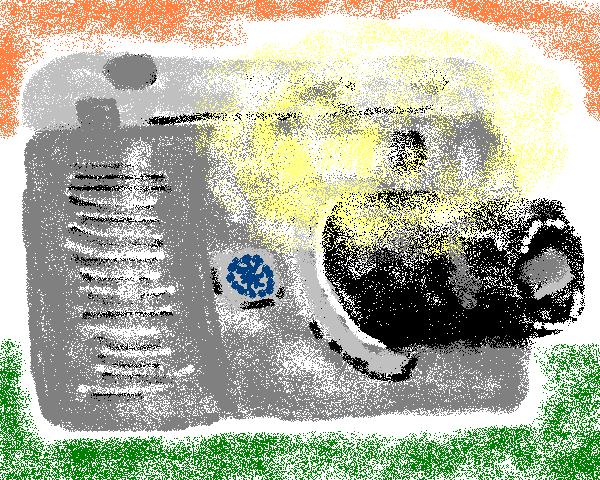
digital camera superimposed over national flag of India

Probably one of the most well-deserved Oscars I've seen awarded in a long time. I was lucky enough to have gone to see it at the Kendall Sq. Cinema before the Oscar ceremony two weeks ago Sunday. In and of its own right, an excellent film, Born into Brothels runs the gamut of emotions, and challenges the viewer's notions of mores, innocence, and the power of education.

Chronicling filmmaker, Zana Briski's journey through the brothels of Calcutta to document the lives of sex workers, her subject immediately shifts to the lives of the children also living in the Calcutta red light district. Taken by their energy, curiosity, and engaging characters, Briski begins to teach a small group how to frame and compose photographs. She issues them small automatic cameras that the children then use to document their lives in the two crowded alleys comprising their forbidden world. This serves a dual purpose. The children, more adept in negotiating access to the inner-lives of the sex workers, clients, and other denizens of the Calcutta brothels, are better able to capture life inside the brothel than she was. Also, it propels her beyond her initial mission of documenting the lives of sex workers to taking active steps to help their children out of their desperate circumstances; ones that for several (the girls in particular) would result in their own entrapment into the skin trade.

The beauty of the film lies in Briski's humility. Unlike many fictional stories and documentaries of Westerner's visiting and observing the peoples of a developing land, she opens herself to the trials and frustrations that the children and their parents face in their dire circumstances. Her simple digital camcorder is unwavering as it records the joys and sorrows of her subjects, including herself. And moreso, in her humility, she shuns the center stage in deference to the children, allowing their pictures, their voices, and their actions to relay their individual and collective stories to the audience. And from them, she draws inspiration and an education on perseverance, and the capacity of the human spirit. Because for its many tragic moments, and overall tragic circumstances, the children remain children: laughing, playing, uncannily observant and creative, and despite all that besets them, full of life and dignity.

As educators, we witness a curriculum in action, rich with potential real-world outcomes. Not only do the children apply what they learn from Briski's coaching, but they also collaborate through interactive discussions, viewing and critiquing each others work. They talk directly and with striking maturity about the emotions their pictures convey and their rationale behind their pieces: selections of subject, setting, framing, lighting, angle, etc. They discuss the theory, apply it in the field, then revisit the theory to critique and learn further from their end products. Briski takes this a step further by inviting other photographers to teach a class and discuss the children's work with them, by setting up a gallery showing for local affluent art aficionados, and in an episode with all the theatrical suspense of a Hitchcock thriller, submits the work of one of her charges for entry to an international youth photography summit. One couldn't ask for more authentic performances of understanding and assessments!

The most transformative experiences for Briski and the children lay in her attempts to get the children into the local boarding schools. With the inherited stigma affixed to children of sex-workers, the schools were loathe to accept them. Even the hardest hearts in the audience tearfully succumb to the children and Briski's rollercoaster of triumphs and defeats as school after school finds reason to not admit the children. Even with potential admission, the children still face the obstacles of family that may wish for them to stay in the brothels, financial burden, as well as the fears and homesickness any 10 year-old would have in leaving their only home.

Born into Brothels serves as a persistent reminder of why I came to the School of Education in the first place. Briski, a photojournalist without formal training as an educator, armed only with a love for her art and the children with whom she shares it, provides the children with and herself gains transcendence over unimaginable odds. If in the heart in every educator there lay a Zana Briski, the world could truly be transformed. Until then, start by spending the 8 bucks and two hours to have yourself touched and transformed by these incredible children, Born into Brothels.

Thursday, January 27, 2005

Cidade de Deus

drawing of discharging revolver superimposed over Brasilian flag

I had avoided seeing City of God when it was in theaters a couple years back for fear it would be too depressing. What a lame fuckin' excuse. I continue to hang my head in shame. Thankfully, I've grown up a bit since then, having gone to see Dirty Pretty Things in the theater (and a few times since on DVD) and plan to see Hotel Rwanda as soon as it's released. My roommate's Netflix queue has now allowed me redemption, as the City of God DVD arrived several days ago and I finally summoned the courage to watch. In doing so, I was richly rewarded.

City of God (Cidade de Deus) is the story of a ghetto (favelas) of the same name on the outskirts of Rio de Janeiro, Brasil. The tale of the Cidade is told over three decades through the lens of favela resident Rocket (played incredibly by Alexandre Rodrigues), the narrator/protagonist/guide. Himself Afro-Brazillian, he eventually comes to tell the tale of his home-favela, not only to us but to his countrymen outside the favelas through the lens of his camera. Through the eyes of Rocket, life on the edge of paradise is replete with bitter irony, humor, tragedy, and every now and then, a miracle. The Cidade is a dark and empoverished lining to Rio's rich silvery-white cloud. The Rio of the movies is so often the exotic and picturesque backdrop to romance, mystery and glamour, featuring non-African and usually non-Brazillian characters. It is very refreshing to see the story told on the other side of paradise, in the voices and persons of the favela's neglected and forgotten residents (conspicuously more racially mixed than any American ghetto portrayed on film, television, or in the news).

Rather than moving scenery, the multitude of characters are skillfully crafted of heart, sinew, and spirit. In some cases, a seemingly incidental character resurfaces supplying essential color and direction to the story. At many points when I first viewed the DVD, I wanted to rewind to see exactly when some of these characters first appeared. In this way, the filmmakers achieved a masterpiece both in craft and content.

A number of reviews have criticised the film for its highly stylized imagery juxtaposed to brutal violence. I think what reviewers found most discomforting was not the presence of violence so much as the violence being executed largely by adolescents, some characters even as young as 9 or 10. The clever camera work and violent gunplay have been familiar friends to gangster tales since The Godfather. I think the fact that the film shows the horrifying reality of the young and impoverished as the footsoldiers and in some cases capos of the horrible enterprise gangster films depict. The tragedy and horror as depicted in the Cidade is that much more real, and by turn, the film's commentary about violence, poverty, and their intersection, a much more powerful and responsible one than any other film I've ever seen.

City of God was not the foreign language grief-fest a more cowardly AFroNaut had originally anticipated. It told its story with a deft combination of humor, tragedy, levity, pathos, and sobriety. I remember hearing an Asian film critic saying of Hong Kong films that the target audience in China, paying its hard earned cash, expects to experience the full range of human emotions in the two-and-a-half hours entertainment they've paid for. I and all others whom I've spoken to about City of God felt we'd definitely gotten our two-and-a-half hours worth. I think because of the nature of the tale, the levity became that much more a comic relief, and the tragic, that much more poignant. Don't deny yourself this rich experience. Most importantly, don't deny the children of the City of God (and the many cities like it, at home and abroad) of your witness to their ongoing struggle.

see more at: